Playing pretend but for adults?
TLDR;
Performing in front of a camera
- Readings
- Lecture Notes
- Research
- Weekly Task
- Find a photograph of a performed event – preferably one of your own life eg portrait ceremony, fashion, social event
- Explain why you’ve chosen the image:
- What aspects of the image suggest the subject is “Performing”?
- Can you identify any performative behaviour taking place in the image that constitutes the subjects identity?
Readings
Summary from Butler, J. (1988) Performative Acts and Gender Constitution: An Essay in Phenomenology and Feminist Theory
Speaking overall, Butler argues that the concept of gender isn’t something we’re born with but something that we do. Something that we’re told and taught how to do and be. They breakdown the idea of roles assigned to these actions and their social standing accordingly. If you are female, you must follow these specific rules, roles and be inferior to men. If you are male, you are to work and provide and be protective/assertive.
They talk about Gender being a script and performance, one that follows a binary system and reinforces power and hierarchies. They begin challenging the idea that with this, comes n assumption that these genders must naturally align. However with these being a “construction through performance”, they’re also open to challenge and change. With recent decades breaking these norms and moving past the binary identity, as well as the creative freedom society has started developing with our own outward expression, it’s breaking down the stereotypical societal norms.
Walking away from this, Butler speaks of gender less as a biological requirement but as a concept forced upon you. It’s a performance you’re expected to play, shaped by power and societal rules. But with this, comes the expectation for new generations to break these rules and refuse to play along. We’ve started seeing this with the open access to the internet and ability to reflect who you are more, with support and reduced consequences.
Lecture Notes
Discussing the concept of “Self” is always a fun one. Mainly as Freud makes an appearance. You can never escape Freud!
As someone who has struggled with the concept of “Who am I?” for a long time, I have always interpreted the “Self” as different layers. The person you are on your own, around your close ones and in public are different iterations of the same being. It’s like you wear a different identity for certain people, whether knowingly or not.
There’s the Normative Behaviour meaning you’re following the societal norms and being a member of society but then these rules can change on a dime. It used to be socially acceptable to smoke around others, now it’s deemed rude and unsafe. The regulations that make up how you interact with people are difficult to understand as there’s no official list. For me, that’s a rough one. I struggle interacting with the general public and attempt to be a textbook perfect person as to not “put my foot in my mouth” so to speak.
The concept of “Gender Identity” is always a fun one to discuss, mainly due to the discourse and misinformation available about it. How people chose to express themselves, whether as a goth or as a non-binary gender identity, it entirely their own choice. Unfortunately, the general (and often ignorant) public like to share their thoughts where they’re unwanted. Personally, as long as you’re not offending or hurting anyone – you do you 🙂
Family Identity is also an interesting one. I’ll use my fiance to explain how I interpreted this one. To me, he is “Ed”. He becomes a relaxed, calm person who is happy in his own little world. Once we come into range of his family, he becomes “Edward”. It’s a subtle shift however he becomes more stoic, solid and defensive. As Ed’s family are of the “Posher” variety, his personality shifts slightly to match. We joke that he starts using his silver spoon once the family are around.
This idea that we almost revert back to our Teenage selves once family are around is one i wholeheartedly believe in. Own personal research from years ago found a connection between “Familial roles” and reactions to family in adult hood. It’s very much worth a read!
Escapism is definitely something I can talk about and delve into. It’s something I am a master at! 🙂 We look for an escape from the real work and, subconsciously end up recreating what we’re going through. We’re stressed with work but end up playing a simulation game. We’re having issues with people, end up reading about relationships or friends.
Once you introduce a camera into this mix, one of two things will happen. The subject will either overexaggerate their person or remove it completely, reverting to a different being. Not only that, thanks to the easy accessibility to camera’s, we have become tuned to knowing when a photo is being taken so change how we are within seconds.
Juno Calypso – Joyce
This is one of the examples Dan gave and I fell in love with the idea.
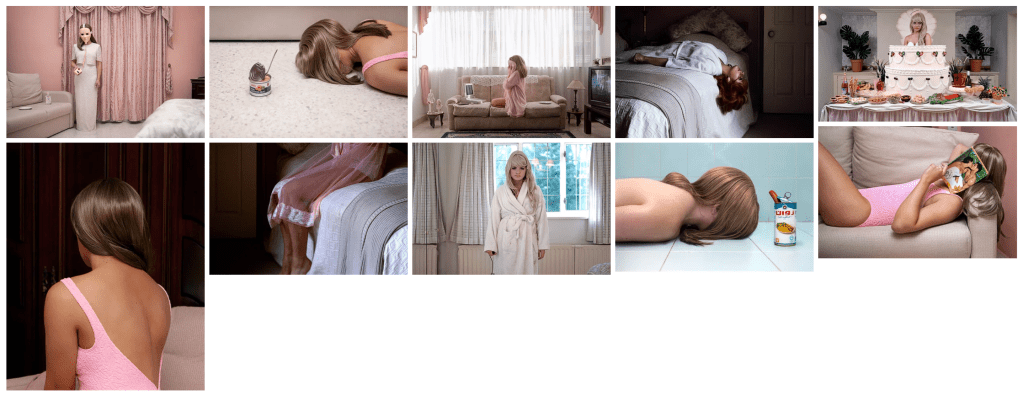
Creating a “character” that fits a specific set of societal rules and showcasing that life. It reminds me almost of “Death Becomes Her” and the character Meryl Streep plays. The housewife obsessed with her look and the power it gives her.
Research
Turkish Women & Girls
I came across this collection when scrolling through Aperture.org and found it fascinating. I’ve never understood or heard about this type of Muslim experience and upbringing.
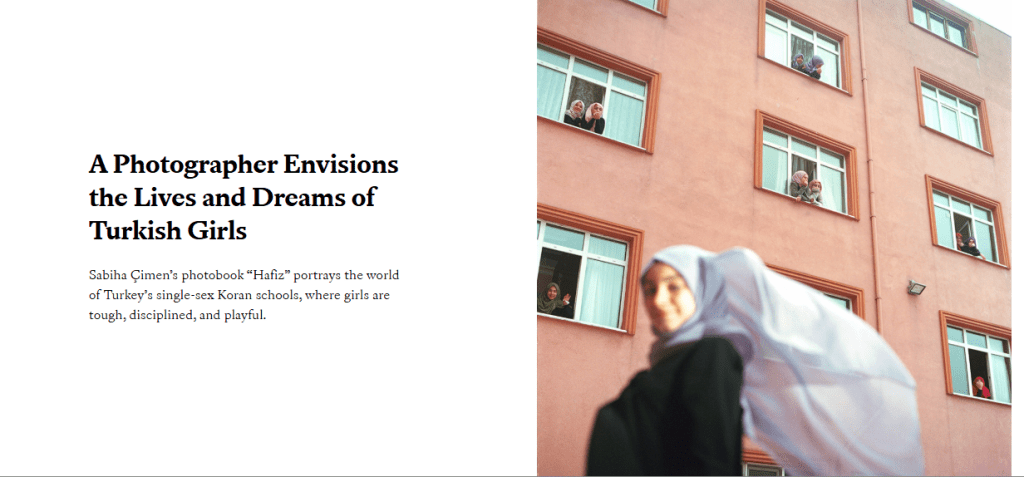
These children are set to a specific, single-sex school to learn the Koran, cover to cover. Throughout the article, Çimen talks about her upbringing at this school and how Turkeys “No Headcovering” ban impacted her and removed part of her identity. Because of this, she wasn’t able to attend university and found solace in Photography. Using this medium, showcased what life was like for the girls at these Guardian Schools and what it means for them.
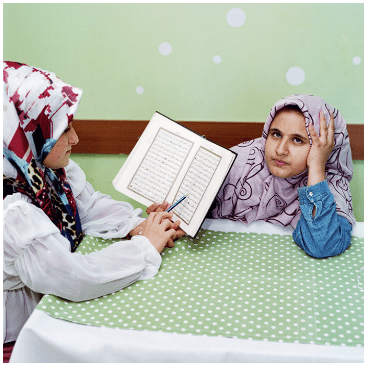
The caption states their attempting to recite passages to each other. The reason I love this one is the mix of colours. You often associate hijabs with being dark colours and boring. This is not the case however, often they are bright and used to reflect a persons identity. Style and design of a Hijab is on the same level as styling and colouring your hair.
Focusing on the actions and “performances” within the image, this plays nicely along the fiction/non-fiction line. We all know this pose, we’ve made it ourselves when studying. The “I’m done with this” look from our right side subject mixed with the “C’mon, we’re nearly done” posture of our subject on the left. It creates the Tutor/Tutored idea.
Narrative Power of Clothes
While searching through Aperture.org, I came across an interview between two fashion designers, discussing the impact clothing and fashion can have.
They start off discussing how they founded their line, breaking down the stereotype of Parisian fashion and building up a line that takes from a range of different backgrounds. Being a Paris based fashion brand, they understand they have an associated history.
They aim to break this mold and create a brand that includes a range of heritage, backgrounds and themes. Focusing on their Spring/Summer 26 collection, it tells it’s own story:
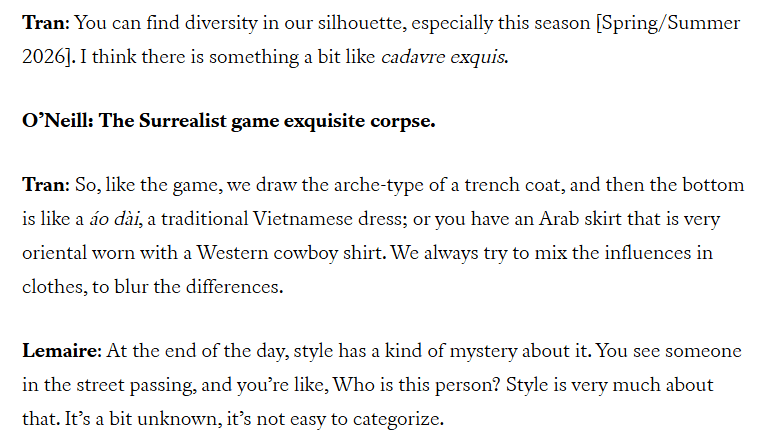
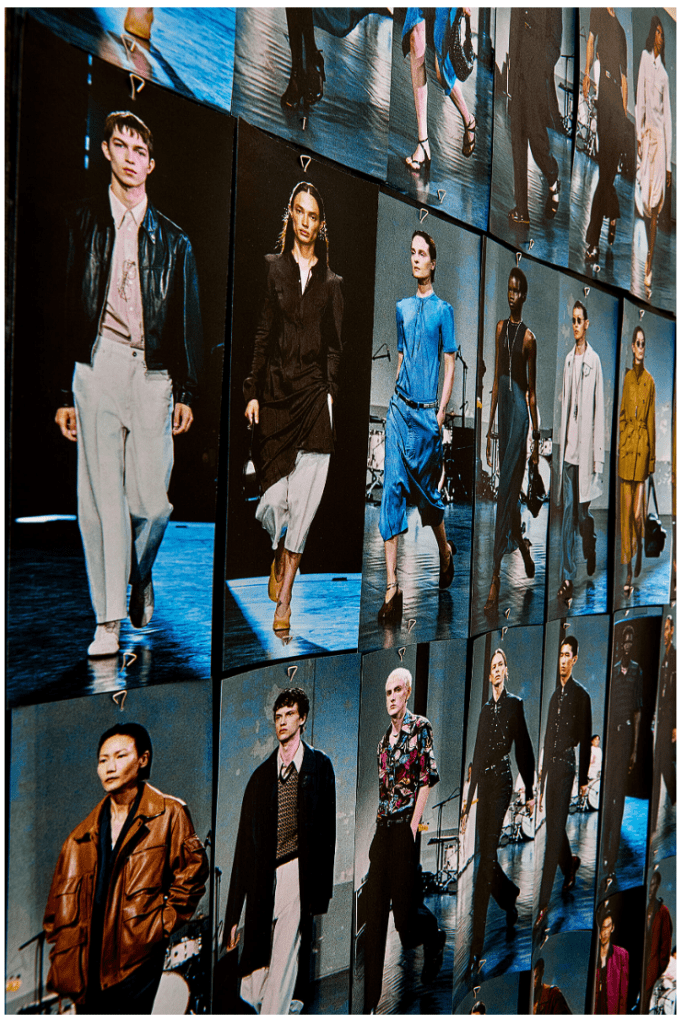
I’ve never been someone that understands “High Fashion”. My only experience to that world is “The Devil Wears Prada” and “Creators In Fashion“. The idea of blending the stories though, that is a wonderful idea. As stated above, a western trench coat blended with a traditional Vietnamese dress, creating something both new and old. People are a blend of cultures and stories, clothes are a reflection of ourselves so why not combine the two?
There’s a psychology behind the clothes we chose, mixing our emotions and identity, as well as our own confidence in ourselves. For myself, I prefer comfort over style. That being said, I am still someone who is prone to dressing up once in a while. On the flip side, my partner is someone who prefers dressing up instead of down. He prefers the “Look good” over the comfort. Once a camera is involved however, he loses the ability to hold himself correctly, overthinking how he looks. On the flip side, I openly do not care how I look. I expect them all to look “naff”.
Weekly Task
Find a photograph of a performed event – preferably one of your own life eg portrait ceremony, fashion, social event
Explain why you’ve chosen the image:
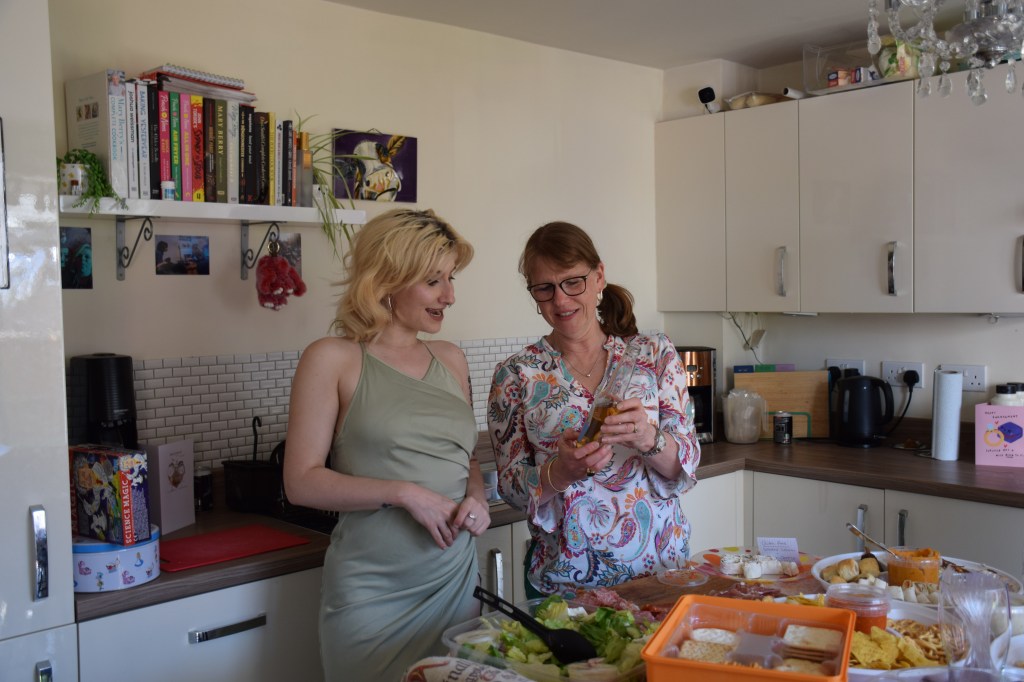
This is from my own engagement party. Although together 5 years at this point, our families had never actually met. This event was a very stressful event for me and one that I dreaded for some time. I asked a friend to photograph for us so that people were not stuck in their phones, taking photographs.
This photograph is of my Mother-In-Law (MIL // right) and my closest friend Lottie (left). This photograph is special to me as it’s proof that my friend can talk to anyone and always be pleasant.
On a personal note, I chose this specific image as there is a deeper meaning to it for those close to my family & Lottie. We know that my MIL is not an easy person to talk to and this image has been used as proof that Lottie can talk to anyone. For me, as someone who’s known Lottie for 20+ years, I can tell from it that she’s not comfortable with the interaction.
What aspects of the image suggest the subject is “Performing”?
Both are dressed up for a formal event. Lottie more extravagant than MIL, signifying a younger, more unique experience. With the added context of an engagement party, you can deduce that Lottie is of a more influential figure from this, demanding some attention with the outfit but the colour dampening this. MIL’s outfit being more casual and tame meaning she’s used to these experiences and is comfortable in social settings. Wearing the extravagant dress, it’s implied that Lottie is not used to these experiences.
On a deeper level, looking at the interaction between the two, you can see a few different context clues to what’s going on.
MIL’s body language is relaxed and almost welcoming, attempting to show Lottie something on her phone. Reading Lotties body and facial language, we can deduce that it’s something Lottie is less-than-interested in. Lottie’s figure is very rigid, and poised, indicating a played emotion over genuine. Her face is that of someone who is feigning interest but is attempting not to hurt MIL’s feelings. The tight grip Lottie has on her hands also indicates that she’s uncomfortable with something.
Can you identify any performative behaviour taking place in the image that constitutes the subjects identity?
With it being a large event, both were aware there was a photographer around. They know they’re to be on Best Behaviour and want to look good at all times. They want these photographs to be “amazing”, both for their sake and ours (Mine & Ed’s). They’re attempting to remain natural and genuine while discreetly posing for a camera. Lottie is more ridged, posing either for the camera or the interaction. Whereas MIL is more relaxed and calm with the interaction.
From the above mentioned reading of body language, you can deduce they are not mother/daughter but do know each other. There’s no physical interaction between the two implying they don’t know each other very well but enough that they can converse. With this being an Engagement Event, you assume they’re from two different families.



Leave a comment