
ABC, 123, etc etc.
TLDR;
Archives & Catagorising Images.
Readings
Opening paragraph from Michel Foucault (1966) The Order of Things: An Archaeology of the Human Sciences
Similar to Barthes, this writing style seems to be very metaphorical. It’s taken a fair few read throughs to get my head some-what around what is being said. Here’s how I interpreted it:
Something as vast as the Animal Kingdom, something so incomprehensible that we are still discovering new species, had been broken down into a dozen categories. I did some digging and found it was called the Celestial Emporium of Benevolent Knowledge from a fictitious taxonomy. Which means that it’s not a real concept, which would explain the humorous response our author had.
Taking something massive and breaking it down into a few smaller groups isn’t a suitable management solution. You’d need a much larger, or more generic, indexing system. An amusing fact to me was that the first section was “Belonged to the Emperor”. As they are so mighty that he has his own classification of animal. Whereas I laugh, it did remind me that technically the British Royal Family own all swans and dolphins within British Waters. So isn’t that far-fetched it seems.
Walking away from this excerpt, the archival aspect of animals, being we deem below us, cannot be something as simple as 12 tags. Even now, we struggle to keep them under the classifications we have. If you’ve seen some of the deep water creatures, they’re less “Fish”, more “Eldritch Horrors”.
Excerpts from Rose,G. (2014) Visual Methodologies
The concept that archives are inherently bias is an interesting one that I’ve not considered before. However, once you consider it, it does line up. Something like the education system, one designed to teach the next generation, is bias towards raising a specific type of child and will only supply the data to fuel that ideal.
Historic Archives try to tell a specific story based around what they’re archiving. Very few hold a neutral opinion however, can you be sure of that. They will hold what appeals to the general public for donations or the government for funding. Unfortunately, this means that if their government says “jump”, they jump.
Moving onto Foucault and his breakdown of the Panopticon, it screams Orwells 1984 to me. Even now, the concept of “one subject is seen without ever seeing, and the other sees without ever being seen” is horrifically accurate to society is going through now. We are surrounded by cameras, webcams / Phones / CCTV, but never know if we’re being watched. You hear the horror stories of peoples webcam’s being streamed to the dark web and it creates a paranoia. I fell for the paranoia myself, my webcam is unplugged or covered.
Bringing it back to the original comment that you’re required to trust a photograph, that becomes harder depending on who is holding it. If you’re finding it in an archive, you’re expected to trust the context around it. If you’re finding it online, you’re expected to trust it was a human that took it or even that its correct for what you’re looking for. You are expected to believe what you see while remembering the fact it could be a lie.
Lecture Notes
Organising is my jam! I love having everything in order and knowing where it is. Working in retail, stock counts and POS displays were some of my favourite bits. Just me, the stock and the numbers.
The idea of “Everything in Order” is a weird one. It can mean you’ve got your cookbooks lines up or it can mean you’ve ordered everyone around to get things done. It links back to the idea of hierarchies too. Your boss will order you to get things done because they are “superior” to you. Items can be catagorised as such too. Certain things can be deemed higher value or importance depending on its “tags”. It also creates a subconscious set of rules alongside it.
Focusing on Foucault’s aspect, the concept of power shifts. Most imagine that power is held by leaders and high-end groups however, he argues that it’s something that operates withing everyday aspects. He states that knowledge and power are interlinked with each other. You can’t have one without the other.
To reduce power among the people, they reduce the amount of knowledge they have. The aspect of schools, sectioning the children based on age, skill set or even gender in some cases, mean that the “dumb stay with dumb” and the smart rise up. Everyday systems add labels to people, healthy & sick, smart & dumb, good & bad. In this, it causes our world views to shift and change according to the rules set by the Upper World.
Moving on, the concept of the Panopticon adds to this argument by adding the aspect of surveillance. Take Orwells 1984 for example. Big Brother is always watching so you’re always on good behaviour, you follow the rules and you’re aware you’re being monitored. That being said, you’re never certain you’re not being monitored. It’s stops being literal and starts becoming a mind game. 1984 does take this a step further though, adding the concept of “Thought Crime” which, given the way society is moving and the idea of internet surveillance, isn’t too far removed.
Overall, the idea of order and classification creating hierarchies isn’t actually too far removed from the world now. Search Engines, a major tool in everyone’s life, shows results based on the higher payer, not on relevance. The idea of a modern panopticon shift the rule sets on how we interact, document and perceive the world. Creating an almost uniform experience or expectation for life.
Research
World Press Photo Awards & Scandal
The main thing a photographer holds is the cl;aim to their own image. It is theirs, they took it, they hold the right to be credited as such. When it comes to International Awards, You’d assume that they’ve got systems in place to prevent someone else taking credit for something not theirs.
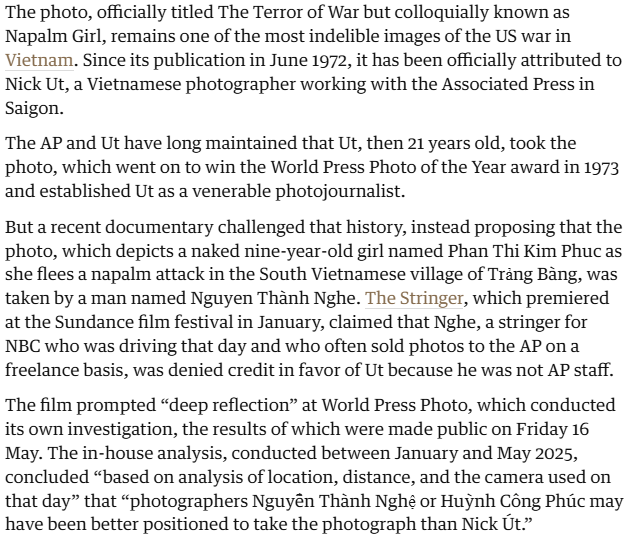
Unfortunately, World Press Photo awards ended up with a scandal on their hands. A documentary identified that the iconic photograph, Napalm Girl, had been incorrectly attributed. This then threw it’s victory in the 1973 World Press Photo Awards into question.
AP – Associated Press //
Breaking this down, due to the photographer not being official AP staff, they were not allowed credit. Instead, handing it over to someone else who it would “benefit more”, so to speak.
This then feeds into the idea of the upper world (in this case AP) dictating who should have the work because they deemed it better, whether it’s morally right or not.
This then forced World Press Photo to back peddle massively and shift their tone. In their statement later on they mention:

If this doesn’t scream “We don’t know so no one gets it”, I don’t know what else does. They have now shifted the award from Ut to the photograph itself, regardless of who took it.
Because someone decided that the authorship was to go to Ut, someone else was denied opportunities and experiences. They were catagorised as “not worthy” of such, just because they were freelance.
“Bad” Photographs
As someone who falls victim to their own insecurities, it’s easy to become demoralized by a “bad photograph”. I wanted to see if I could find someone who specialised in the idea of a bad photograph. That’s when I found an article in “Casual Photophile” discussing the idea of a Bad Photograph and what it means for it to be “bad”.

The author speaks of how everything we see is orchestrated to be as visually pleasing as possible. Whatever the algorithm asks for it is supplied. The author argues that the idea of a bad photograph is dependent on what gets bought, sold or shared. Whatever looks “Perfect”.
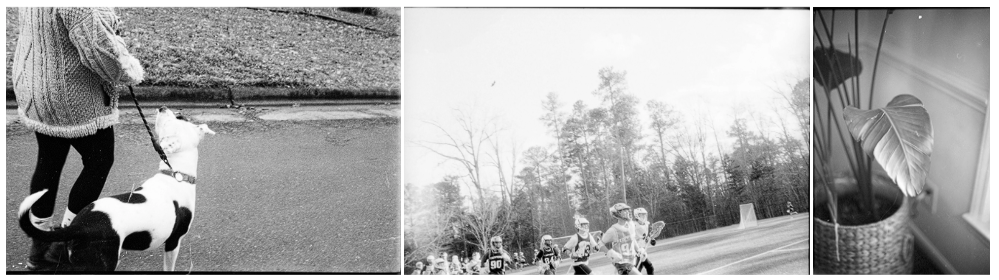
The idea of a bad photo is solely based on whatever rule set you’re following deems it to be. Social media means you follow the algorithm, Auctions mean whatever sells to the highest bidder. Not what you deem interesting or pleasing. A quote that laid this out perfectly was:
In a world that praises perfectionism, bad photographs are an opportunity to look without judgment, to see what is and what was, what became of a moment in time.
Society demands perfect, literally uses the phrase “Picture Perfect”. Anything that is less than is deemed bad. But there is no official rule set to state it’s bad. As we’ve covered these last few weeks, photography is subjective to the eye of the person. I could look at something and deem it bad when someone else would think it’s amazing. We judge our own work based on our own rule set, or the rule set we’re taught to follow.
With this, its demoralized a whole category of photographers who want to break from the norm and explore other routes. If it’s not instagram-able or sellable, you assume the world doesn’t want it. The list of rules the “Upper Art World” has set, trickle down to the hobbiest and starting up photographers who then create their work accordingly, forgetting that art, photographs included, are all subjective.
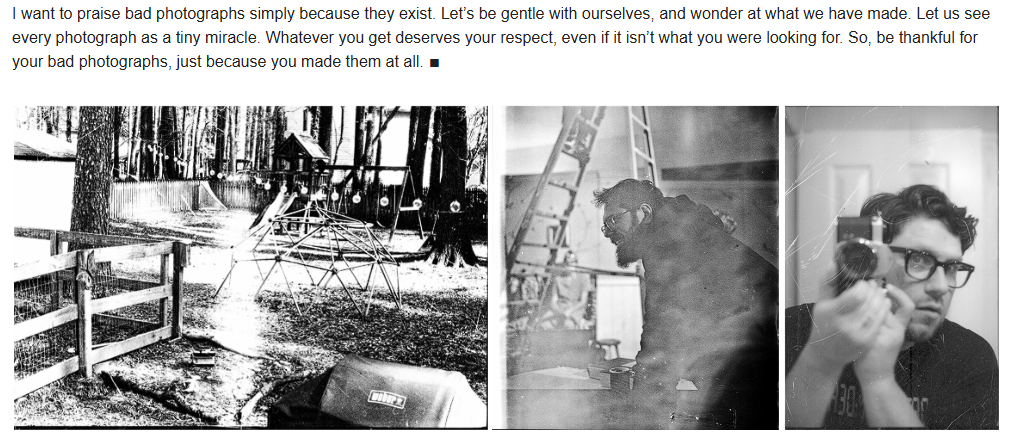
Wrapping this up, It was the last paragraph of the article which stood out to me. A message of hope and encouragement to all photographers.
Weekly Task
Find an image or images from an archive or collection of any sort.
Yuka Morii’s line of Pokemon TCG Cards

Specifically:

Explain why you have chosen the image.
When discussing collections and archives, I immediately go to my own collections, specifically Pokemon. Although uncommon for an adult to be interested in a childrens toy, it’s something that is special and important to me and my family. Something I’ve been building, on and off, since I was around 5.
Specifically, I think of my favourite mini-collection of the artist Yuka Morii. She makes clay models of the creatures and photographs them in real-world environments. Mixing two of my favourite hobbies, Pokemon and Photography into one little card. Most TCG cards are based off of something animated or digital. Having a real-world example of these creatures is unheard of and unique to Pokemon.
I chose the Froakie card mainly as it’s one I’ve got an excess of due to my own collections. It’s one that isn’t special, isn’t expensive but holds the special imagery of a “Real” Froakie. Something that isn’t ever actually going to be possible. Unless we get a Jurassic Park-style Pokemon Adventure 🙂
Describe the archive it belongs to and discuss the criteria used to categorise it.
Talking literally, all cards are categorised by 4 specific details:
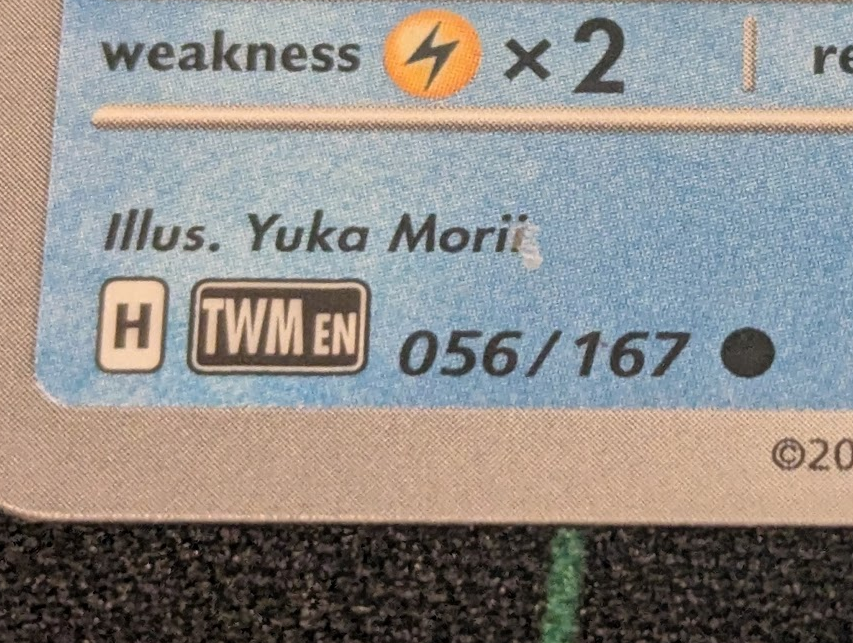
H – Competative TCG rotation – States if it’s active in national tournaments.
TWM en – The set & language (TWilight Maskerade English)
056/167 – 56th Card out of 167 in the set
Black circle – Common rarity card.
All card printed belong to the Pokemon TCG Archive. Every card ever made is stored here. It’s broken down by multiple catagories from “Sets”, “Types” and even down to the creatures and their evolutions.

However, when catagorising for a collector, it depends on the type of collector you have. A few notable ones:
- Child Player Collection – Plays for fun.
- Do they like the card? Does it lead to something good? Can it win them the game? Can it do damage?
- Adult Player Collection – Plays for Competition.
- Does it cause damage? Does it evolve into how they want to play? Can it win? is it apart of the meta? Is it game legal? Is it banned?
- Child Collector
- Is it one of their favourites? Does it look cute? Does it mean something to them?
- Adult Hobby Collector
- Is it a favourite? Is it a specific artist? Is it from a specific set? Is it a misprint? Is it worth collecting?
- Card Trader & Seller
- Is it worth money? Will the value go up for it? Is there someone who would buy it? Can I make a profit from this?
You then have outlier collectors who cause havoc within the spaces for “funsies”. One example is self-declared “Kabuto King“. He solely collects cards titled Kabuto from the original set in 1996. Creating a scarcity, with the intent to artificially raise the prices. Whereas this hasn’t had the intended effect, there are people out there who create movements like this to make profits.
Rosie’s Rant about Scalpers
There is a whole sub-catagory of “Collectors” called “Scalpers”. They intentionally buy out as much stock as they can to artificially raise the prices of products, creating scarcity and demand. The best example is from a recent set called “Prismatic Evolutions”. A Elite Trainer Box (ETB) retails at around £45-£50. Because of the “Scalpers”, they now sell online for stupid money.
It has ruined the game and collecting abilities for everyone, children and adults alike. No one in their right mind would spend £650 on something retailing at £50.





Leave a comment