Mechanical additions to the world of Photography
TLDR;
The digital world colliding with the real one. Very Matrix-y
Lecture Notes
Although I missed this weeks lecture, I’m working from the Notes left behind. Reading through, I’ve interpreted it as “Mass production diminishes art”. Not only that but also how media produciton can influence and control the output. Think of it like a machine.
Art/Photo goes in, Machine picks if it’s profitable. If it is, mass produce it until it’s dead. If not, throw it on the pile.
This can also mean over production too. Where something becomes a “trend” or “statement” and it’s covered to death. I reference it to the Youtube Algorithm. If it sees that a topic, for example “Skyrim” is doing weirdly well, it will push it to the top. After a while, more and more creators will jump on the bandwagon and it’ll become too popular. Meaning that everyone creating that content will take a hit and it will die off once again. Rinse and repeat, just changing the topic.
Moving on, Dan’s notes mentioned a scene from Pixar’s Monsters Inc – Specifically the “Scream Simulator”. Mentioning how we assume it’s real at the start as that’s how the scene is set up. Only to have the literal and metaphorical curtain raise and the illusion broken.
Thinking like that, the Camera creates a stage. Very much like a live show, we are spectators to what the camera shows us. Due to the way photographs are used, we’re expected them to be true depictions or very clearly staged. Whereas, in matter of fact, photographs walk a fine line.
Following the notes, there is then a discussion regarding AI and it’s implications and effects it’s having on Photography. I plan to discuss this later on in this weeks research however, if used solely as a tool, it can be beneficial. It cannot replace photography.
Research
Banksy & Their Identity
Reuters have allegedly named and revealed Bansky’s identity. As someone who loves Banskys works, statements and iconography, I find this heart-breaking and unnecessary. What’s wrong with having some mystery in the modern day?
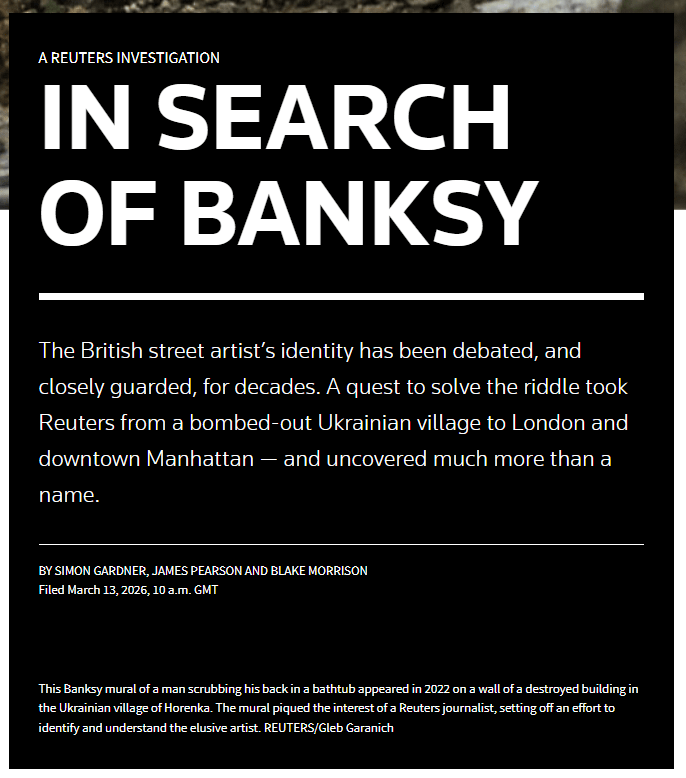
Part of the appeal of Banskys work was that we didn’t know who they were. Because of that, they get away with very controversial actions and statements. Not only that, it’s become a major statement for the Art World. You can be this influencial and iconic creator, all while hiding who you are.
Side Note
You see this a lot with online creators now. They hide their personal lives and identities through avatars, characters or even just pseudonyms. With the rise of V-Tubers and VR Models, protecting ones identity has become so much easier within the online world. That being said, hiding it in the real world is a lot harder.
One that sits with me is a content creator called Fillian who brought a friend on as a fictional mother. At a convention, said friend revealed herself (partially) as said fictional mother. Removing the illusion and ending that chapter.
Reuters have tried to force Bansky’s hand into revealing themselves and ending this chapter. Thankfully, this has not been the case as of yet.
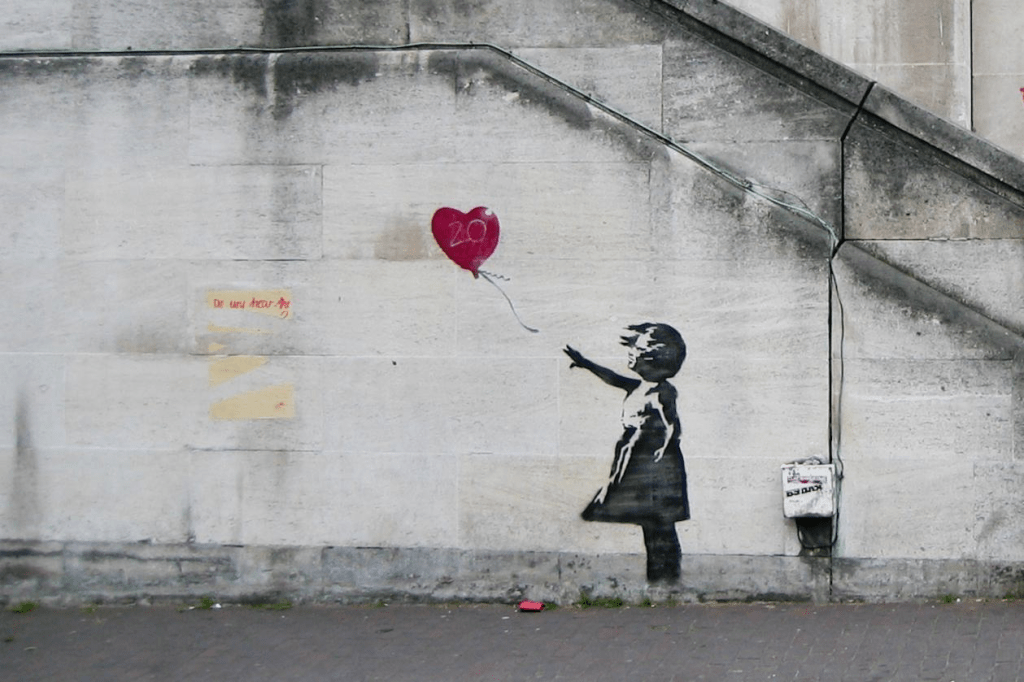
A personal favourite and one of his most iconic statements was with “Love is in the Bin”. This is where his iconic piece “Balloon Girl” was set to shred once it had been sold. Unfortunately, the shredder jammed half way through and it remains as the piece we know today:
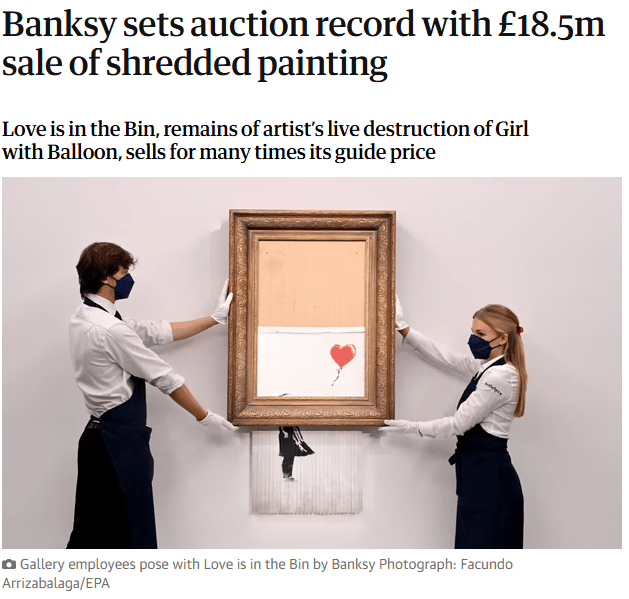
Unfortunately, this had the opposite effect of what Banksy wanted, to render the piece useless. Instead it sold for £18 Million. Following this, the Auction House stated:
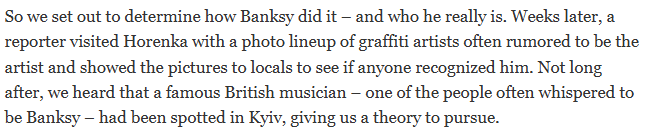
Reuters report states that it comes from a place of curiosity following his piece in Ukraine. Worried about how he’d managed to evade Russian Troops. His identity being a secondary research matter.

Rosie’s Ramblings
This feels like it was a slow news day for me. That they’d run out of ideas and wanted to solve one of the UK’s biggest modern mysteries. Clearly Jack the Ripper wasn’t enough for them.
However, not only has it caused anger towards Reuters but has also removed the key selling point of Banksy – The fact we don’t know who they are. They’ve also put this person they’ve identified at risk, regardless of whether they’re the artist or not.
The best example I can think of is when Top Gear “revealed” that Michael Schumacher was The Stig. Although a promotional stunt, the internet can be an influential & gullible thing and believed them anyway.
To summarize, by attempting to reveal the artist, they’ve diminished the hold the artist has over their work. They risk ruining the illusion and preventing more from happening. Banksy’s team is now in damage control mode, attempting to prevent the damage done by Reuters and move forward. All while a major reporter is shoving their nose in where, as stated in their own article, the general public don’t even want it.

AI “Art”
Forewarning – I am strongly against AI “Art” and will do my best to stay neutral during this section. However, no promises will be made.
To quote Dan’s lecture notes:
Ais do not innovate, they synthesize and re-imagine, but they don’t actually create anything new.
By this definition, can you classify AI Generated media as “Art”? If it’s just regurgitated imagery and in some cases, stolen imagery, how is it not just theft of work?
The BBC had a run of articles titled “AI v the Mind” which covered the growing impact AI has had and competed it against a human. On this specific example, they looked at creativity and artwork.
It starts by recounting Marcel Duchamp and the shift he caused with his Urinal, declaring it as “Art”. Later in the article, they talk to Philosopher Alice Halliwell and she states the following:
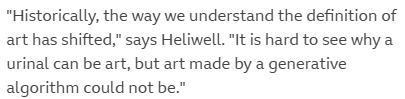
I would agree with this statement. Shift your mindset and maybe the Urinal could be classed as Art. However something made through an algorithm that you have to feed other peoples work could not be.
This then opens the question of where does collage / Photomontage artists come in? Are they not classed under a similar bracket? Taking someone elses work, repurposing it and making it something else.
Rosie’s Thoughts
When we covered Photo montage last semester, I really struggled with the concept of taking someone else’s work (Image, Art, Etc) and repurposing it. To me, it felt like theft. We hold the potential to take a picture, twist it’s meaning and create something else entirely, completely changing the narrative. The big difference between Photomontage and AI is that people would seek consent from the original artist to do so. AI does not. It takes media off platforms, a lot of the time unknowingly to the creator, twists it and spits out something along those lines. As someone who works with creators that have had their work stolen by AI, I refuse to participate.
To summarise my stance – anything made using a generative AI is not “Art”. It is an amalgamation of different artists shoved together without their consent. When Larian Games came out stating that they’d “possibly” used AI in their concept art stages, it broke my heart. A developer that I have supported for a long time turning to a machine instead of people to create assets for their games. It later came out that they’d used it to write placeholder text which, whereas not as horrific, still something I wasn’t comfortable supporting. Now, a few months after the initial scandal, I still am uneasy on supporting a Longtime Gaming Love.
Moving on, there was an “AI Art Auction” back in February 2025 which was hit with major backlash from public and artists alike.
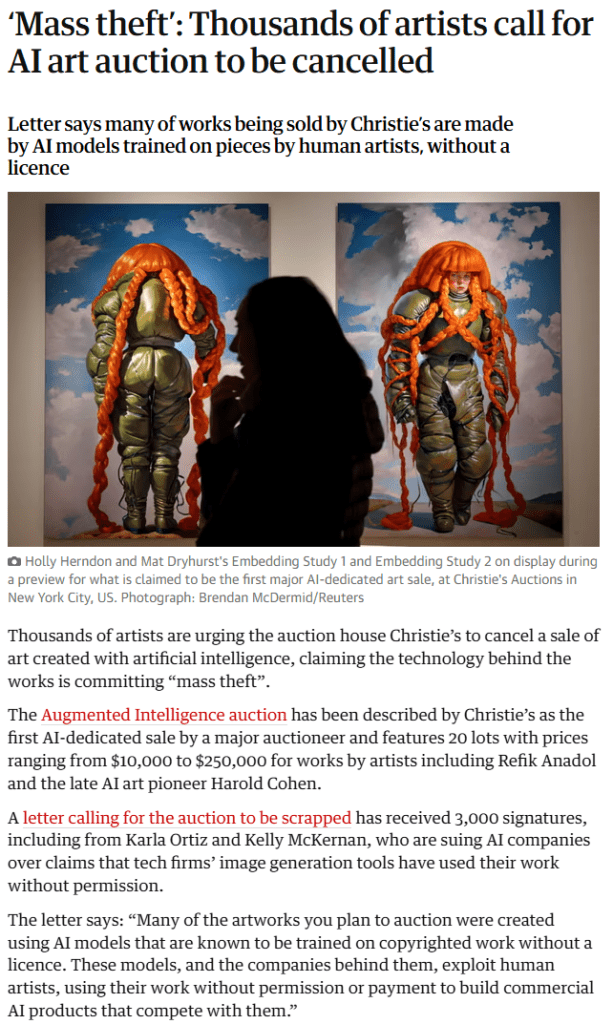
Image Generation AI need to be fed information to be able to spit out anything. The AI Models used copywrited materials without the consent of the artists and/or without a licence to do so.
All that being said, AI is not inherently horrific. I am not completely against AI. My main gripe is from the wrong people being behind the wheel and when it’s stealing livelihoods away from people. There are aspects of life where AI can benefit us. From assisting with research, to helping those without and detecting things the human cannot.
My personal issue, and one shared by a large population, is the corporations training these models. They’re able to twist the narratives being fed to these machines and receive no repercussions for it.
There are people attempting to redirect AI development and correct the impact it’s having. One of which is an organisiation founded by creators, backed by scientists, called Real Good AI. They actually released an article a few weeks back titled:
It breaks down the science behind AI art, why we’re drawn to it and why there is a boundary between AI and Human Art. I won’t delve too deep into it as it’s really worth a read. I just want to focus on one key part – The intent.
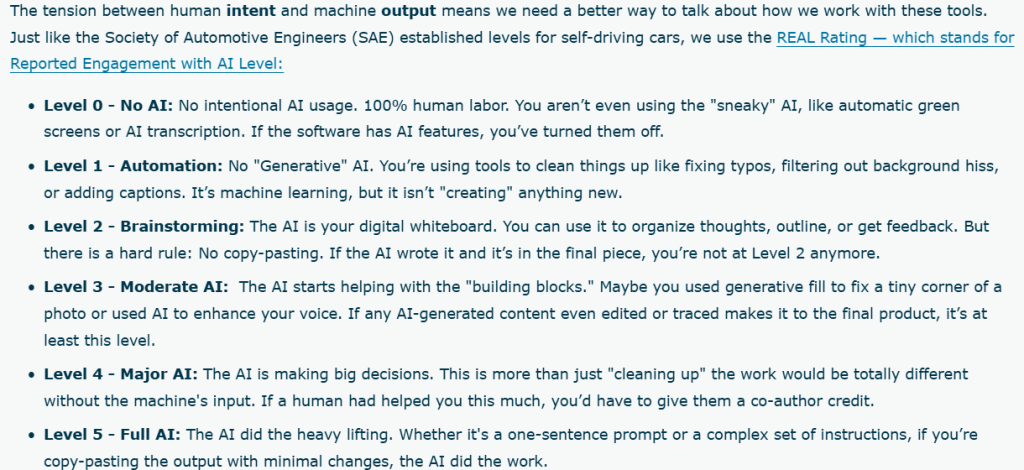
AI, at the moment, is unrestricted. We are able to create whatever, whenever. This means that AI can be used whenever and there are no repercussions for it. Steam recently required developers to declare when AI has been used in their games, following a similar system to that above. Whereas the public were happy with this choice, the developers were not. Knowing that the general gaming population were against AI being used in creation project a la video games. Even rival CEO’s have made comments stating how, forcing developers to declare AI will cause players to judge games differently.
Wrapping this up, AI “Art” can not be compared alongside Human made art. This is due to it requiring assets to be fed to it that where originally human made. In human art, every detail is intentional. In AI, it’s because it was there.
Digital Perspective on Women
Following a brief glimpse into Louis Theroux’s “Manosphere”, I started looking at the history of women in the media. It seems that, as a society, we are reverting back to the older viewpoints of Women and forcing roles & stereotypes upon impressionable young children.
In modern society, most teenage girls will post to sites like Instagram, Snapchat and Tiktok. Alongside that, most don’t have the privacy settings they should have. They will see the older influencers and use them to reference to how they should be in life. Not being of the mental understanding that 90% of what we see on these platforms are perversions of the truth.
My experience with Social Media / Body Image
As someone who grew up with the birth of Facebook, Instagram and other platforms alike, I too fell victim to the Influencer aesthetic. My teenage years were fuelled by recent trends, challenges and what influencer said what. I would class myself as lucky that I couldn’t keep up with the changing of the the trends, I was contempt with my games and shows.
That being said, I did fall horrifically into the “Body Positivity” pit which dramatically impacted my mental heath, self confidence and relationship with my “self”. Even now, at 25, I’m struggling breaking through the model bodies, skinny lifestyles and the “requirements” these platforms force upon a teenager.
Historically, images of women have largely been created and distributed by and for the male gaze. With the arrival of social media, many women were given ownership over their image for the first time.
Women have control over their image. However, the views and money come from the men. We create what the audience want. It’s basic supply and demand. If you want to have a career as an influencer or model, you need the social media standing. To get that, you feed your audience. However, you must play by the rules of the platform.
Tumblr T&C’s Controversy
In recent years, there has been a lot of controversy regarding the female body and social media posting. One that stands strong in my memory is the 2018 change of Tumblr’s T&C’s which caused a spark in the “Free the Nipple” movement.
To summarise the build up, Tumblr is a micro-blogging platform that allows users to build communities for anything. This includes safe places to discuss usually taboo topics like Sex, Kinks and other “NSFW” topics. It also allowed safe spaces to discuss topics like Eating disorders, mental & physical health, to name a few. In 2013 Tumblr was bought by Yahoo and they starting cracking down on the more “Adult” and controversial communities. They started strong, removing a lot of hate groups, adding PSA’s to groups about Depression and Suicide. However in 2018, they started, what the internet dubbed, “The Porn Purge of 2018”.
They started hiding any tags that were classed as “Not Safe for Work” or 18+ behind an optional “Sensitive” filter. However, after a massive CP / Sex Trafficking issue was identified, Tumblr had to make drastic changes, removing ANY content that was classed as 18+. In their T&C’s, the specifically called out “Female Presenting Nipples”.
As I’m sure you can imagine, this caused a stir across the internet communities.
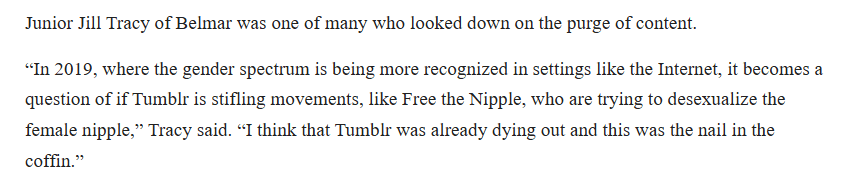
As we stated above, the image of the female form has been returned back to the female. However, content platforms are trying to restrict certain aspects. Most theorise this is due to Tumblr wanting to keep a hold of it’s shareholders. However, it caused a major setback in the communities this platform had built and caused over 100 Million users leave the platform behind.
The Disney Female
Disney are iconic for their Princesses, starting with Snow White up to their recent addition of Moana. (Mirabel isn’t classes as a Disney Princess, just a heroine). However, the effect their content has on young children and the ideals they imprint can shift the narrative dramatically.
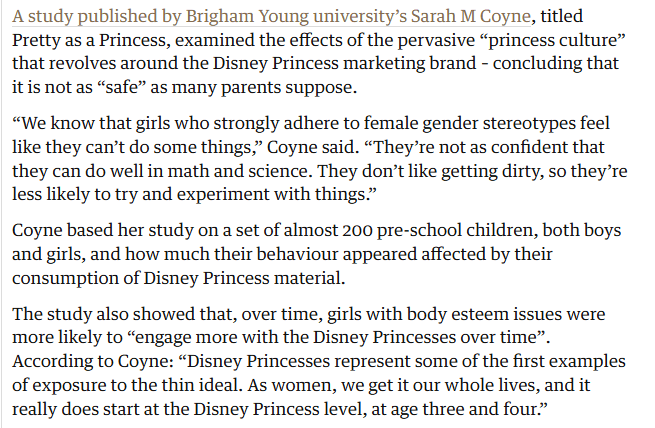
As children, we are introduced to media like films, tv and games. Parents will head towards the long-term family friendly brands like Cbeebies, Disney and Dreamworks to help development through the crucial years. With recent additions of Youtube Kids, reinforcing positive role models has become increasingly harder. Disney have the “Thin, Pretty and Dependant” model for their princesses, only straying from this in recent years with the addition of Moana and Encanto. Dreamworks however have always tried to shift the narrative away from the pretty princess with the creations of Fiona (Shrek) and Gloria (Madagascar).
Marketing wise, Disney seems to suck the personality out of their princesses and revert them back to the Pretty, Sparkly dresses. As mentioned below, Belle was loved for being an outcast reader who threw herself to save her father. In the marketting, she’s all dressy and sparkly to appeal to the younger children.
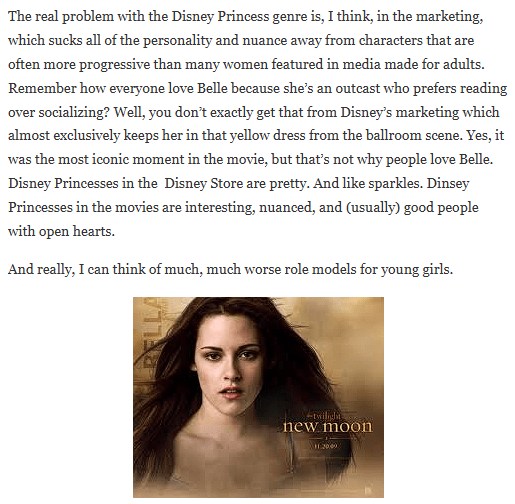
That all being said, this is dating back to the 2000’s and 2010’s. In recent years, we’ve had content that shifted the narrative dramatically, showing the “real” female as best they can.
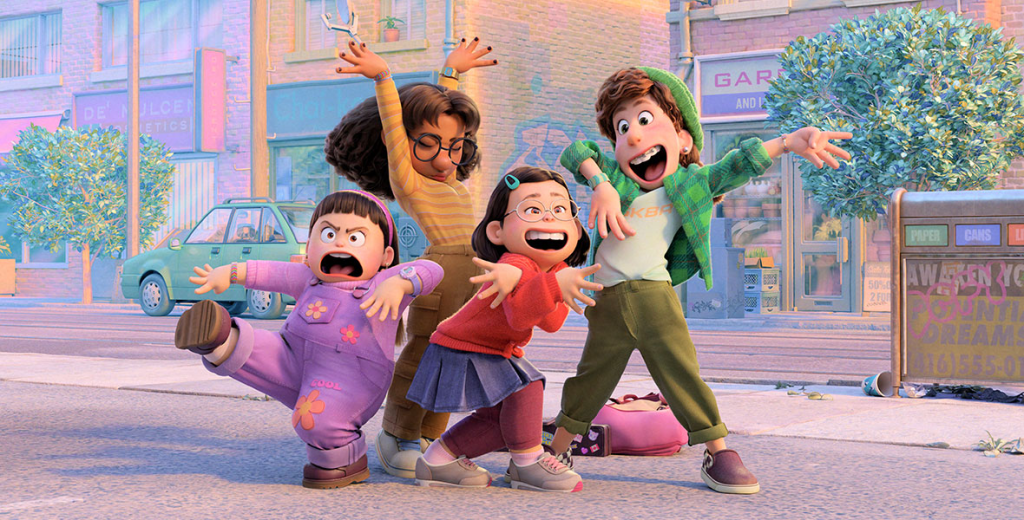
Pixar’s Turning Red has a main cast of different figures, identities and personalities. They’re unique and do not follow the “Thin and Pretty” stereotype.
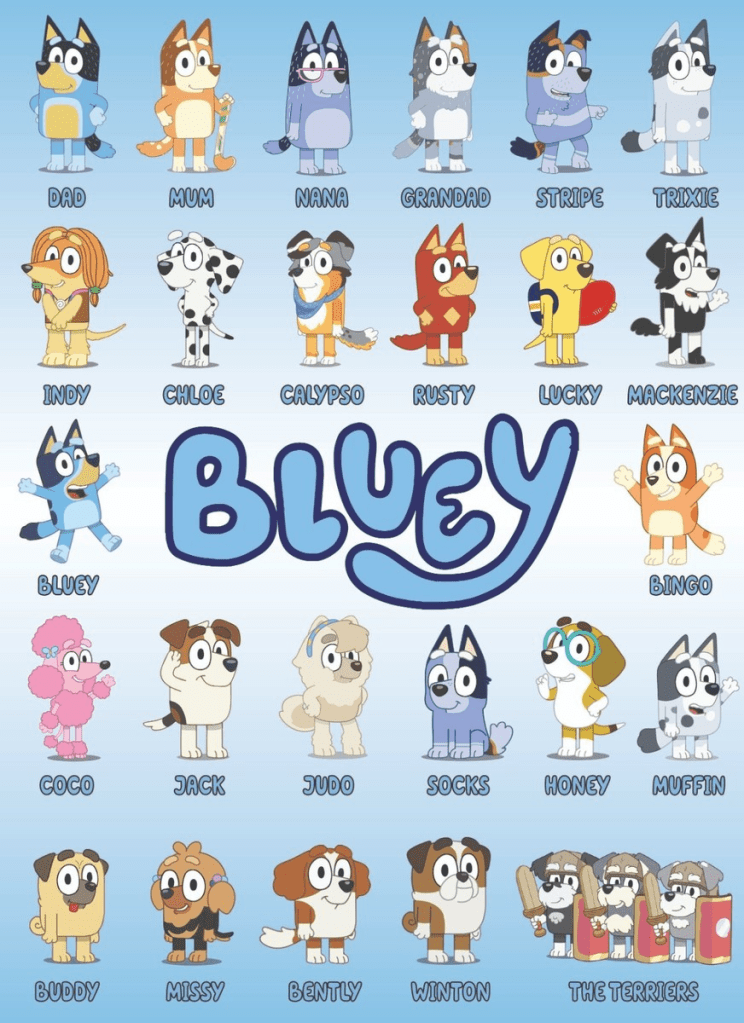
Bluey shows two creative children aswell as the realistic parents doing their best. It covers topics previously untouched due to possible repercussions. Episodes dedicated to the Deaf, the grieving or even just the loss of certain aspects of childhood. Although a show aimed at 4-8 year olds, it introduces them safely to the world around them and shows how everyone is different.
Yes, media has started shifting the narrative of the Female Body. However, this is dramatically shifted back once social media gets involved. Films & TV Shows are creating a more accurate “Woman”, removing the Helplessness and Dependent nature forced upon the character throughout history. That being said, once Social Media steps in, you’ve got to “Feed the Algorithm” and give it what the audience want. If you want the views, feed the audience the sex appeal. When teenage girls start on social media, they see these women feeding the algorithm, gaining the attention and views and mimic the behaviour. Leading to mental health crises, body confidence issues and dire need to grow up.
Weekly Task
Find an image that represents digital culture in some form.
1. Explain why you have chosen the image.
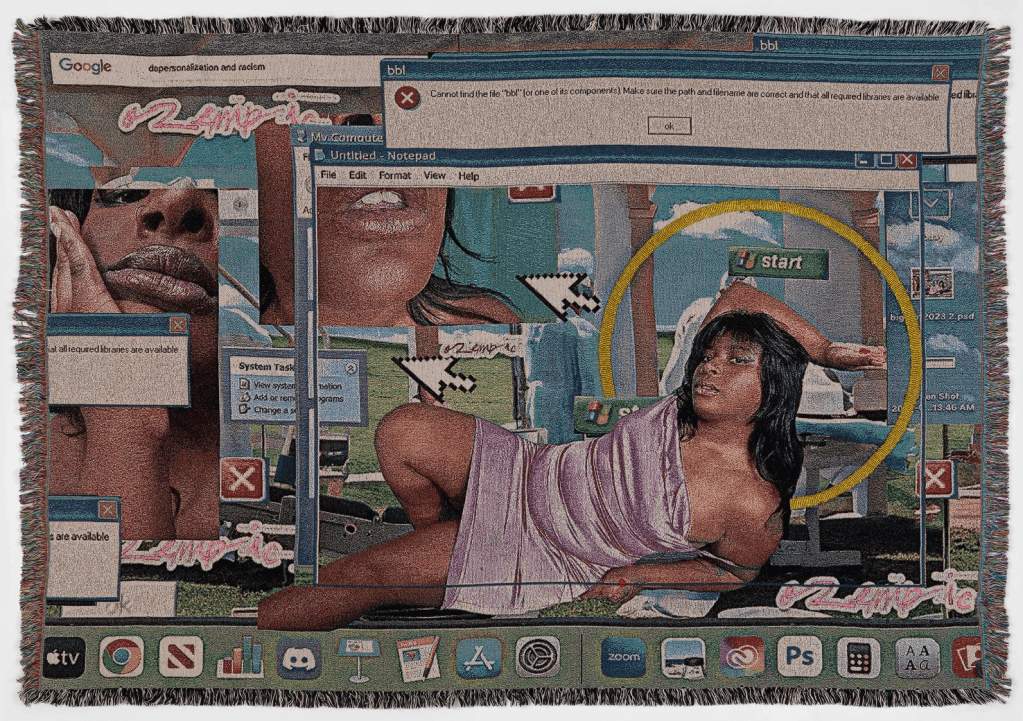
Initially it was due to the mix of technology shown in the image. A Mac taskbar with Windows 97 popups and glitches across the screen. The only legible popup states “BBL Cannot be found”, referring to a Butt Lift. After further contemplation the concept a digital body plays into the previous mentioned “lie-ves” told by influencers. There is also the irony of it being a digital image, containing computer iconography, all printed on fabric and displayed as a tapestry. The title “Girl Dinner”, in reference to the Meme, stood out with me also. “Girl Dinner” is what we refer to in my home as “A dinner that shouldn’t be a meal but is”, for example a bowl of chicken nuggets. Whereas not a suitable meal, is a meal all in the same. In reference to this, she is not your typical “model” figure, but is a model all the same.
Heading down the rabbit hole, I chose this one as it had a few aspects that I felt connected with:
- Our model isn’t perfectly thin. She’s what the internet would class as a “Curvy Girl”. As someone who is also not of the thin varity, seeing the body rolls and natural curves mixed with the internet idea connected with me.
- The mixture of new and old technology (New Mac taskbar, WIndow 97 OS) almost show that body confidence has plagued the internet since the beginning.
2. What does the image say about digital culture or the changes in
photography and/or society.
Photography wise, it’s becoming more and more digital. With the developments in AI, Photo manipulation software, you can never tell what is the original image and what isn’t. The addition of different OS show it’s across the “Network” so to speak. You assume the image of the woman is legitimate however the connotations around it imply it’s made for internet. Meaning filters, enhancements and editing.
Earlier we mentioned how the image of the woman, has been returned to that of the woman. However this piece makes a statement that the image belongs to the computer. It’s digitally made, digitally altered and included notices to BBL’s, a procedure made to enhance the figure for the male gaze.


Leave a comment